Realm economy of mutuality and sharing
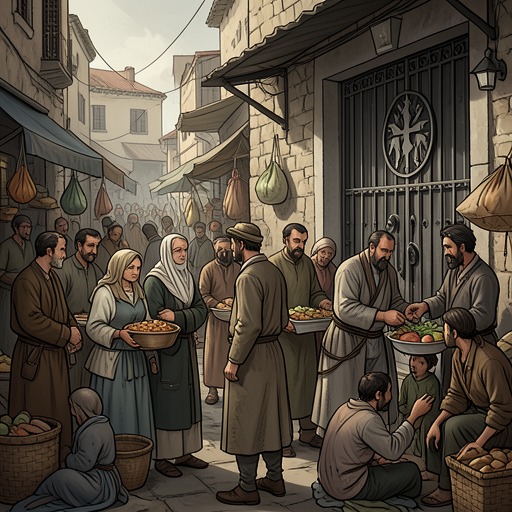
Acts of the ApostlesThe Realm economy of mutuality and sharing names a communal way of using material resources to provide for one another and embody, in the present, the abundance and security associated with the Realm of God. In Luke-Acts, sharing is more than charitable assistance: it makes people’s material well-being a shared responsibility and gives economic life a visible role in the community’s witness.
Purpose and Principles
Luke-Acts draws on the Jewish conviction that material resources should benefit everyone in the covenantal community. The aim is a life in which people can live in peace and security, without being consumed by anxiety about survival. When that anxiety is relieved, people become more available to serve wider purposes of love, mutual support, justice, peace, and abundance.
The contrast between the old age and the movement toward the Realm is not a contrast between material life and a purely spiritual one. It concerns how goods are used. An old-age mentality turns resources toward private advantage while neglecting the community; the Realm’s economy directs material goods toward common life. Sharing therefore has both practical and symbolic force: it helps meet material needs, and the willingness to place resources at the community’s service signifies a response to the Realm.
Common Possessions and Solidarity
Acts describes the believers as being of one heart and soul and says that they held their possessions in common. The account may suggest that members sold goods and placed the proceeds in a common treasury; some scholars instead understand that private ownership remained and property was sold as needs arose. The interpretation differs, but the account’s central point is that possessions served the purposes of the community rather than private accumulation.
This is economic solidarity, not simply a series of donations to a congregation. Members become mutually responsible for one another’s security, a practice that anticipates the material dimension of the Realm. The text also presents sharing as a blessing to both poor and rich: it relieves the poor of the exhausting search for provision, while offering the wealthy a way out of greed and the temptation to make wealth an idol. In a community where security is shared, the wealthy too can find release from anxiety about their own provision.
Relief Across Communities
When Agabus predicts famine during the reign of Claudius, Gentile disciples in Antioch send relief to believers in Jerusalem. Their offering makes the ideals of the shared community concrete across a boundary between Gentile and Jewish believers. The Gentile community becomes an instrument of provision for the Jerusalem church, and the transfer of resources signifies the reunion of Jewish and Gentile peoples. It also anticipates a vision of the future in which Gentiles place their resources in the service of the God of Israel.
The same logic appears in the account of Lydia, a wealthy Gentile seller of purple in Philippi. After her baptism, she and the household she heads become part of the community. Her presence signals that people of means need not stand outside the church’s life and mission: their resources can serve as provision for others, while participation in a mutually supportive community offers them security beyond attachment to wealth.
Economic Witness and Its Oppositions
The book’s account of sharing presses beyond a charity model in which individuals give occasional help to the poor. It calls instead for economic solidarity and for confronting structures that sustain poverty and justify widening gaps between wealthy and poor. The contrast is dramatized in Ephesus, where Demetrius and the silversmiths connect the sale of Artemis shrines both to their income and to the goddess’s honor. Their defense of Artemis intertwines religious devotion with the protection of profit; the ensuing uproar exposes how an economy organized around money and idolatrous dependence can foster social disorder.
Against that pattern, the economy of the Realm is grounded in mutuality, sharing, and action for the common good. Its claim is not that resources are irrelevant, but that their proper use is measured by whether they sustain a community in which all can live securely. Across common possessions, famine relief, and the welcome of wealthy members, economic practice becomes a way of anticipating the Realm and making its values perceptible in present communal life.